All case studies · Premium retail · Egypt
A premium brand that held a high average order value without discounting
A high-ticket Egyptian brand that cheap traffic was hurting rebuilt its targeting around intent and purchase value, rewrote creative to justify the price instead of quoting it, and held a high average order value with no sale.
Summary
A high-ticket brand was buying cheap traffic that taught the algorithm to find the cheapest available person. Targeting was rebuilt around intent and purchase-value signals, creative was rewritten to lead with why the product is worth its price, and the owner got profit per product on a dashboard refreshed every 30 minutes. The 30 days are in Exhibit 3, and average order value stayed high with no discount.
- Period
- 30 days
- Discounts
- None
- Dashboard refresh
- Every 30 min
Why were cheap clicks a problem for this brand?
A high-ticket brand where cheap traffic was actively harmful. At this price point a low cost per click is usually a warning: the ad is reaching people who will never buy, and every one of them teaches the algorithm to find more like them. The brief was qualified buyers at the price point, with volume second.
What was dragging the average order value down?
- Creative was price-led, which pulled in discount-seekers and dragged the average order value down every time the account scaled.
- The audience signal was built on reach rather than intent or value, so the account optimised toward the cheapest available person.
- The owner had no per-product profit view, so a product with a good ROAS and a bad margin looked identical to one with both.
How were the audience and the creative matched to the price?
Optimised for value, not volume
Targeting rebuilt around intent and purchase-value signals instead of broad cheap reach. Fewer people saw the ads and a larger share of them were plausible buyers at the price, which raised the cost per click and lowered the cost per order at the same time.
Matched the creative to the price
Creative rewritten to lead with the reason the product is worth its price rather than with a number. A premium brand advertised like a discount brand attracts a discount buyer and loses them at checkout, and the funnel then reads as a conversion problem when it is a positioning problem.
Put profit per product on one screen
Everything wired into a live dashboard showing profit per product, per campaign and per creative, refreshed every 30 minutes. On a premium catalogue that view changes decisions weekly, because the best-selling product and the most profitable product are rarely the same one.
What happened over the 30 days?
The 30 days are in Exhibit 3, read off the store back end; the figures stay in the screenshot. Average order value held high with no discount, the audience and the creative finally matched the price, and the owner could see which products carried the margin, which were usually not the ones carrying the revenue.
How this number was measured
- Source
- The store back end (Exhibit 3)
- Period
- 30 days, as shown on the screenshot
- Attribution window
- Not recorded for this case
- Delivery rate used
- Not recorded for this case
- As reported
- Sales, orders and AOV as the store reports them: In the screenshot
- After measurement
- Not recorded for this case
The figures are shown only in the screenshot, not typed on the page.
Raw screenshot: Exhibit 3
The raw screenshot.
Exhibit 3
WooCommerce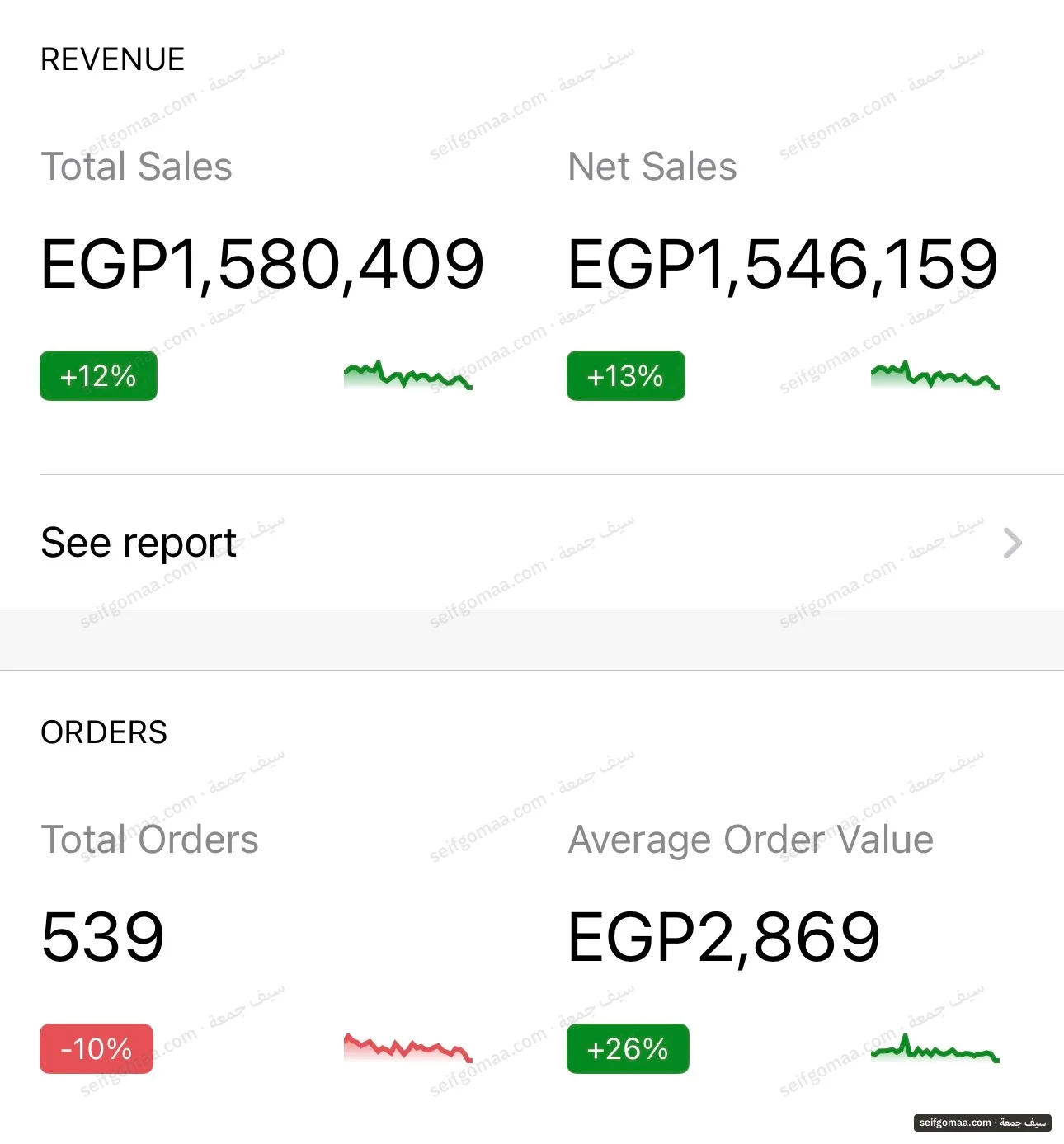
WooCommerce back end of a premium retail brand in Egypt, over the last 30 days as the screenshot states them. It shows sales, orders and average order value. This is the raw screenshot behind the premium order-value case study, where targeting was rebuilt around purchase intent and creative stopped leading with the price.
How do you hold a high average order value without discounting?
If your brand is expensive, a cheap cost per click is not good news. Make the creative justify the price before it states it, build the audience on intent and purchase value, and know the profit of each product on its own so you do not scale the best seller when it is not the one making you money.
The part usually left out
The order count was deliberately low. Chasing more orders here would have meant discounting, and a premium brand that discounts to hit a volume target spends the following year training its customers to wait for the sale.
More case studies
Ecommerce · Egypt · cash on delivery
A cold launch in Egypt: tracking verified before the first pound was spent
Ecommerce · Egypt
+85% month over month without giving back the margin
Coffee · Egypt · COD and Fawry
The account reported 5.48 ROAS. The real number was 1.80.
Fashion · Egypt · cash on delivery
Zero orders wasn't a creative problem. It was a EGP 150 problem.
Silver jewellery · Egypt · cash on delivery
A 618-product catalogue that didn't know its own break-even
Niche perfume · UAE · Shopify
A87 Fragrance: moving a UAE perfume brand from WooCommerce to a new Shopify store